Korvion
China’s data center AI server market is expanding from training clusters to practical inference systems. IDC reported that global AI infrastructure spending reached an estimated $154 billion in 2024, increasing pressure on suppliers to deliver faster and more efficient platforms. This growth gives China’s manufacturers a larger stage, but it also raises harder questions about reliability, energy use, and long-term support.
This introduction examines the China Top 10 Data Center AI Server Manufacturers through a practical lens. It considers GPU and accelerator compatibility, liquid-cooling readiness, rack density, supply-chain capability, and after-sales engineering. The Uptime Institute’s Global Data Center Survey repeatedly identifies power availability and operational resilience as major industry concerns. A powerful server is not enough. It must survive continuous workloads inside a hot, crowded rack.
NVIDIA CEO Jensen Huang said, “The next industrial revolution has begun.” His statement reflects the speed of AI infrastructure investment, yet rankings should not be treated as permanent facts. Vendor scale can look impressive on paper. Field deployment may reveal different results. A data center AI server manufacturer must prove performance beyond a product brochure, including stable firmware, predictable maintenance, and measurable efficiency.
The companies discussed here represent important market participants, not automatic winners. Some may lead in domestic integration, while others remain stronger in global ecosystem support. Readers should verify current specifications, certifications, delivery schedules, and customer references before making procurement decisions. That caution matters, because AI server technology changes faster than many published rankings.
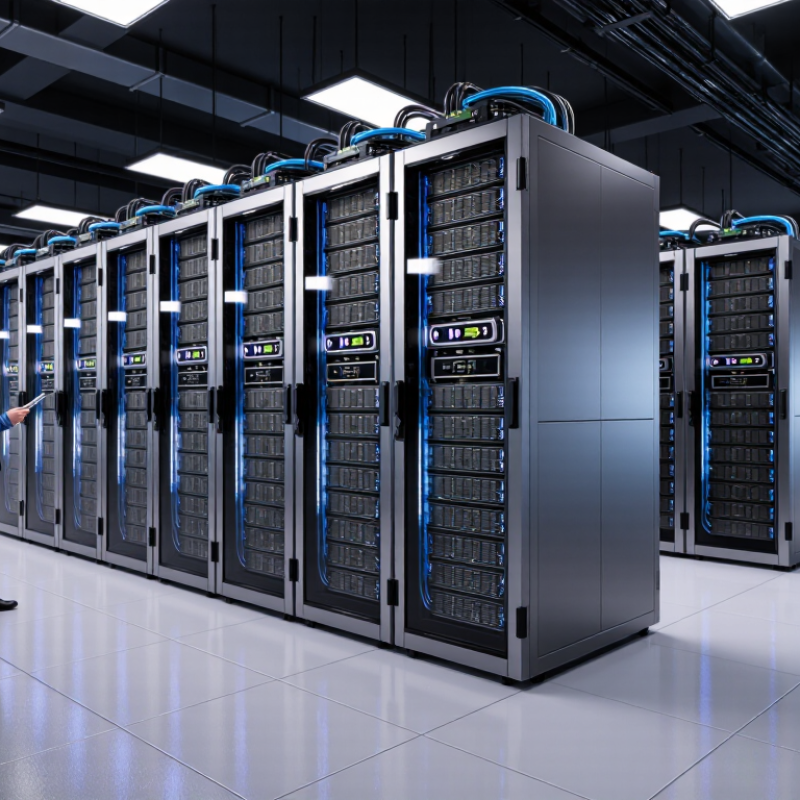
China’s data center AI server sector has developed around dense computing, rapid delivery, and localized engineering. The leading ten manufacturers typically build systems for training, inference, cloud services, and scientific workloads. Their designs often combine accelerators, high-speed networking, advanced storage, and liquid-cooling options.
Heat matters. In a large rack, power density can exceed 30 kilowatts, making airflow planning insufficient for many deployments. Manufacturers now test cold plates, rear-door heat exchangers, and immersion systems under sustained workloads. Engineers also examine vibration, dust, cable routing, and maintenance access. A server that performs well in a laboratory may behave differently in a crowded facility.
Reliability depends on more than processing speed. Production teams validate firmware, power modules, memory stability, and remote management functions before shipment. They also track failure rates during extended burn-in tests. Supply chain flexibility remains important because accelerator availability and component lead times can change quickly. Some designs still consume too much energy during low utilization, which deserves honest criticism. Standardization is improving, but compatibility between platforms remains uneven. That gap can increase deployment time and training costs. Experienced operators therefore compare measured performance, service response, cooling demand, and five-year operating expenses instead of trusting headline specifications.
Selecting China’s top AI server manufacturers requires more than counting shipments. The IDC China AI Computing Industry Development and Evaluation Report 2023–2024 estimated China’s AI server market at about US$23.7 billion in 2023. This figure shows strong demand, but market size alone cannot prove engineering quality. Buyers should examine GPU density, memory bandwidth, interconnect performance, and support for mixed-precision workloads. A credible supplier should provide reproducible benchmark results, not only peak theoretical figures.
Reliability deserves equal weight. Uptime Institute research identifies power, cooling, maintenance, and human error as major data center risks. Therefore, evaluation should include thermal design, power usage effectiveness, component redundancy, firmware updates, and repair response time. The Stanford AI Index 2024 also reported rapid growth in AI investment and computing capacity worldwide. This trend increases pressure on suppliers to deliver scalable systems. Still, published data can be incomplete. Some performance claims depend on carefully selected workloads. That deserves scrutiny.
Tips: Request a live acceptance test using your own models and datasets. Check sustained performance after several hours, not just the first benchmark. Review failure records, spare-part availability, security controls, and engineer training. A practical scorecard can assign 30% to performance, 25% to reliability, 20% to service, 15% to energy efficiency, and 10% to total ownership cost. The weighting is not universal. Your workload may expose different weaknesses.
| No. | Selection Dimension | Weight | Key Evaluation Indicators | Evidence Required | Scoring Standard |
|---|---|---|---|---|---|
| 1 | AI Computing Performance | 18% | Training and inference throughput, accelerator density, memory bandwidth, FP16/BF16/FP8 capability, and performance per rack. | Independent benchmark results, verified technical specifications, and workload-based performance tests. | Highest scores are assigned to systems with strong measured performance across both model training and inference workloads. |
| 2 | Accelerator and Platform Compatibility | 14% | Support for multiple AI accelerators, x86 and Arm server platforms, PCIe and high-speed interconnects, and heterogeneous computing. | Compatibility lists, validated configurations, driver documentation, and deployment records. | Higher scores reflect broader hardware choice and fewer platform-specific deployment limitations. |
| 3 | Scalability and Cluster Design | 12% | Multi-node scaling, GPU or accelerator interconnection, rack-scale deployment, storage expansion, and orchestration support. | Cluster architecture diagrams, scalability tests, network specifications, and documented maximum configurations. | Top scores require stable performance scaling beyond a single server and practical support for data-center clusters. |
| 4 | Energy Efficiency and Thermal Management | 10% | Performance per watt, power capping, airflow design, liquid-cooling readiness, thermal monitoring, and rack power density. | Power measurements, thermal test reports, cooling specifications, and data-center operating requirements. | Higher scores are given to solutions that deliver predictable AI performance with lower energy and cooling overhead. |
| 5 | Manufacturing Capacity and Supply Continuity | 10% | Production capacity, component availability, configuration flexibility, delivery lead time, and multi-site manufacturing resilience. | Factory information, delivery records, supply-chain policies, and customer fulfillment references. | Top scores require consistent delivery capability for both pilot deployments and large-scale orders. |
| 6 | Reliability, Quality, and Serviceability | 10% | System stability, component qualification, failure-rate management, hot-swappable parts, remote monitoring, and maintenance access. | Quality certifications, reliability testing, warranty terms, service procedures, and field-support records. | Higher scores reflect lower operational risk, easier maintenance, and stronger after-sales support. |
| 7 | AI Software and Ecosystem Support | 8% | Support for Linux, Kubernetes, containerized workloads, mainstream machine-learning frameworks, model optimization, and monitoring tools. | Software compatibility matrices, SDK documentation, container images, reference architectures, and developer support. | Top scores require an open, well-documented software stack that reduces deployment and migration effort. |
| 8 | Data Security and Hardware Manageability | 7% | Secure boot, firmware protection, role-based administration, audit logging, encryption support, and out-of-band management. | Security documentation, vulnerability response procedures, management-controller specifications, and certification records. | Higher scores are assigned to platforms with documented security controls throughout the server life cycle. |
| 9 | Total Cost of Ownership | 6% | Purchase price, software and support costs, energy consumption, cooling requirements, maintenance expenses, and upgrade flexibility. | Comparable quotations, operating-cost assumptions, warranty coverage, and five-year lifecycle estimates. | Higher scores reflect better long-term value rather than the lowest initial purchase price alone. |
| 10 | Compliance, Sustainability, and Innovation | 5% | Relevant quality and environmental management systems, energy-management practices, product certifications, patents, and investment in AI server research. | Public certifications, environmental reports, patent records, product roadmaps, and documented research activity. | Top scores require transparent compliance practices and a credible roadmap for future AI infrastructure needs. |
| Total Evaluation Weight | 100% | Manufacturers should be ranked using documented evidence, comparable test conditions, and weighted total scores. | |||
Recommended evaluation method: score each dimension from 0 to 10, multiply the score by the stated weight, and compare the resulting weighted totals. Performance claims should be verified under equivalent hardware, software, workload, and cooling conditions.
China’s top ten data center AI server manufacturers reflect a broad and competitive hardware ecosystem. Their profiles differ in engineering focus, production scale, and customer support. Some specialize in dense GPU servers for model training. Others build energy-efficient systems for inference, analytics, and enterprise automation.
A practical profile should examine processor compatibility, memory capacity, networking speed, cooling design, and long-term service. Several manufacturers emphasize modular platforms, allowing operators to replace accelerators without rebuilding entire racks. Others focus on liquid cooling for high-density deployments, where airflow alone may become insufficient. Manufacturing quality also matters. Reliable assembly, thermal testing, firmware control, and traceable components can reduce operational risk. Public certifications and documented deployment evidence strengthen credibility, although marketing claims still require verification. Rankings may change quickly.
Tips: Compare tested performance, not advertised peak numbers. Request noise, power, and thermal data under sustained workloads. Check spare-part availability and response times. A lower purchase price may create higher maintenance costs later. On-site experience often reveals problems that product sheets omit.
The strongest manufacturers usually combine hardware design with integration expertise. They understand rack layout, power distribution, virtualization, and monitoring. However, no supplier fits every data center. One platform may perform well in a research cluster but waste energy in a smaller enterprise room. Buyers should review workload patterns, expansion plans, and local technical support before selecting a manufacturer. Some evaluations remain incomplete without a live pilot. That is worth acknowledging.
China’s top ten data center AI server manufacturers compete through architecture, platform maturity, and measurable efficiency. The strongest systems combine general-purpose processors with accelerators for model training and inference. Some use modular GPU designs, while others offer heterogeneous chips for lower-cost workloads. Rack-scale systems can improve communication between accelerators, but they demand careful power and cooling planning. Small clusters are easier to deploy. Large clusters deliver higher throughput.
Platform compatibility matters as much as hardware. Experienced buyers examine operating systems, container support, scheduler integration, and driver stability. They also test distributed training across several racks. A platform that installs quickly but fails during recovery creates hidden operational costs. Open interfaces improve flexibility, while tightly integrated software can simplify maintenance. Neither approach is perfect.
Performance claims need practical testing. Useful measures include BF16 or FP16 training speed, INT8 inference latency, tokens per second, memory capacity, network bandwidth, and performance per watt. Thermal behavior matters in a crowded server room. Direct liquid cooling may sustain higher workloads, yet it adds plumbing and maintenance requirements. I would not rely on peak benchmark figures alone. Firmware updates, workload optimization, and technician experience can change results significantly. One overlooked network setting may reduce cluster efficiency. Procurement teams should test representative models, record power draw at the rack, and verify support response before making a long-term decision.
China Top 10 Data Center AI Server Manufacturers
China’s AI server industry is moving from rapid expansion toward more disciplined infrastructure planning. Leading manufacturers increasingly design systems for large language models, industrial vision, scientific computing, and intelligent transportation. Demand is shifting from standalone servers to complete rack-scale platforms with high-speed networking, liquid cooling, and coordinated software support.
Energy efficiency is becoming a purchasing requirement, not a marketing phrase. In a typical data center, dense accelerator racks can create serious heat within minutes. Direct-to-chip liquid cooling, rear-door heat exchangers, and smarter workload scheduling are gaining attention. Domestic component ecosystems are also developing, although supply consistency and software compatibility still require careful evaluation. Progress is real. It is not complete.
Over the next few years, manufacturers will compete through total ownership value rather than processor counts alone. Buyers will examine performance per watt, deployment time, maintenance access, and model-training stability. Smaller regional data centers may favor modular systems, while national research facilities will need massive interconnected clusters. Independent testing remains important because advertised performance can differ from daily production results. This is an uncomfortable gap. It deserves more transparency. Manufacturers that improve open software support, technician training, and long-term service reliability may gain stronger trust than those offering the most impressive specifications.
Check GPU density, memory bandwidth, interconnect speed, and mixed-precision support. Peak specifications are not enough. Ask for reproducible benchmark results.
Run a live acceptance test with your own models and datasets. Measure performance after several hours, not only during the first test. Short tests can hide thermal throttling.
Review cooling design, power protection, component redundancy, firmware updates, and repair response times. Request failure records and spare-part availability. Reliability is often less visible than speed.
One practical model assigns 30% to performance, 25% to reliability, and 20% to service. Energy efficiency receives 15%, while ownership cost receives 10%. This weighting is useful, but not perfect.
Dense accelerator racks can create intense heat within minutes. Direct-to-chip liquid cooling and rear-door heat exchangers can reduce thermal stress. Cooling needs vary by workload and facility design.
Review engineer training, maintenance access, software support, and replacement procedures. Confirm how quickly technicians respond to failures. A fast repair can protect training schedules.
Buyers increasingly want complete rack-scale platforms with fast networking and coordinated software. Standalone servers may not meet large model or scientific workloads. More hardware is not always better.
Some claims rely on carefully selected workloads or short testing periods. Daily production results may differ. That gap deserves honest review.
Compare performance per watt, cooling requirements, and workload scheduling features. Energy costs can accumulate across thousands of operating hours. Efficiency is practical, not decorative.
Smaller regional facilities may prefer modular systems with simpler expansion. Research centers may need large, tightly connected clusters. There is no universal design.
China’s data center AI server industry is developing rapidly, supported by growing demand for intelligent computing, cloud services, scientific research, and enterprise digital transformation. This article examines the manufacturing landscape and explains how leading companies can be evaluated through factors such as research capability, production scale, supply-chain resilience, computing performance, energy efficiency, security, service quality, and long-term innovation. It also highlights the role of each data center ai server manufacturer in building reliable and scalable infrastructure for demanding workloads.
The discussion compares major AI server architectures, including GPU-accelerated, heterogeneous, modular, and customized platforms, with attention to processing capacity, interconnect technology, deployment flexibility, cooling requirements, and total operating efficiency. Finally, it reviews market trends shaping China’s AI server sector, including the expansion of intelligent applications, localized technology development, green data centers, liquid cooling, and increasingly integrated hardware-software ecosystems. These developments are expected to encourage stronger competition, broader application scenarios, and continuous improvements in performance, efficiency, and service capabilities.
