Korvion Korvion

Who Are the Top AI Inference Server Manufacturers in China?

Time:2026-11-03 Author:Isabella
0%

China’s AI server market is broad, and a useful comparison must look beyond brand recognition. Huawei, Lenovo, Inspur, H3C, and xFusion are among the companies buyers may encounter when researching inference hardware. Their offerings differ by processor options, accelerator support, memory capacity, networking, and deployment needs. A product name alone rarely tells the whole story.

For an enterprise team, the practical test may be a real workload: serving a language model to users while keeping response times steady. Engineers should check accelerator compatibility, memory bandwidth, cooling, power draw, and software support. Details matter. A system built for high-density data-center racks may not suit a smaller site with limited power and airflow. This guide compares manufacturers through those operational questions, not just peak-speed claims. It also distinguishes published specifications from results that depend on model size, quantization, software, and configuration. Those caveats can feel inconvenient, but leaving them out would give buyers a weaker basis for judgment.

The phrase ai inference server manufacturer covers a varied field, rather than one standard product category. Some vendors emphasize complete server platforms; others offer broader infrastructure portfolios and partner-based configurations. Availability and specifications can change between generations, so readers should verify current product documentation before making a shortlist. The aim here is a grounded starting point: identify the leading candidates, understand what separates them, and ask better questions before testing a system in production. A ranking can help, but it is not a substitute for workload testing.
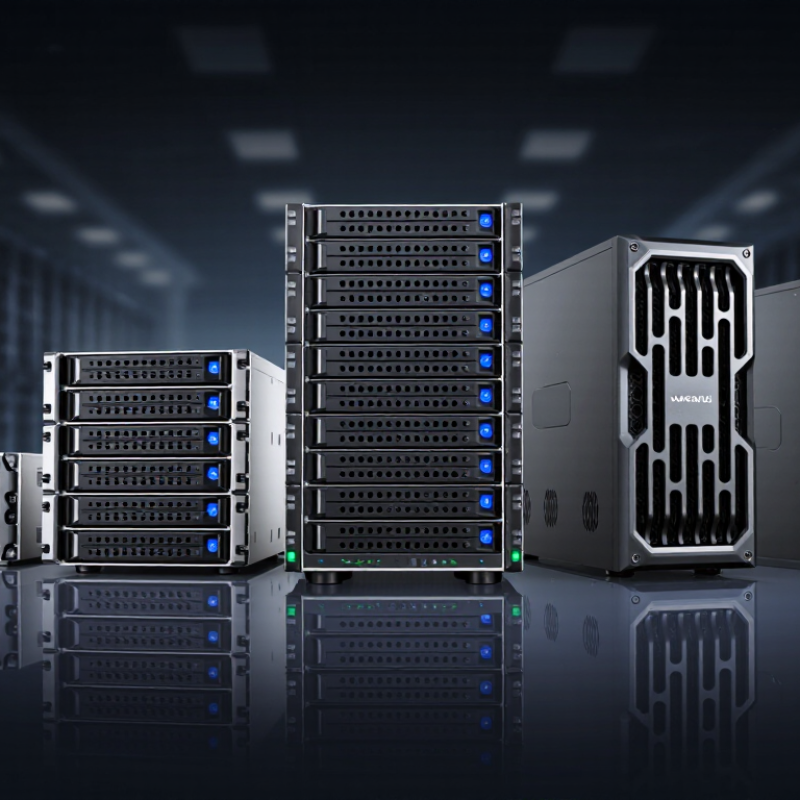
Who Are the Top AI Inference Server Manufacturers in China?

What Defines an AI Inference Server Manufacturer?

An AI inference server manufacturer does more than assemble a rack of accelerators. It engineers and validates a system that runs trained models reliably, often under tight limits on latency, power, and heat. That distinction matters. A server may perform well in a brief test but throttle when several models run through a busy shift.

TrendForce estimated AI-server shipments would reach about 1.67 million units in 2024, up 41.5% year over year. IDC projected worldwide AI spending would reach $632 billion by 2028, with a 29% compound annual growth rate from 2024. These forecasts show rising demand, but they do not prove that every supplier can deliver dependable inference systems.

A capable manufacturer tests real workloads, not just peak specifications. It should document tokens per second, response latency, memory capacity, network throughput, and power draw. Engineers should also verify cooling behavior in a fully loaded rack. Ask for test conditions and repeatable results. The label can be fuzzy. Some suppliers design the hardware; others integrate components and provide system-level support. That difference deserves scrutiny. Buyers should check firmware updates, spare-part availability, and technical support terms, because a fast benchmark means little if a server is difficult to maintain.

How China’s AI Inference Server Market Is Structured

China’s AI inference server market is better understood as a chain than a simple ranking of manufacturers. At one end, server makers assemble systems around accelerators, CPUs, memory, and networking hardware. At the other, cloud operators and enterprise teams specify machines for real workloads. The boundaries blur. Some suppliers focus on complete servers; others contribute through integration, software tuning, or local deployment support.

Demand shapes the product mix. Large cloud facilities often need dense racks, high-speed links, and predictable power use. Hospitals, factories, and research centers may favor smaller systems that keep data close to users. Buyers compare more than headline computing capacity: cooling design, repair access, software compatibility, and delivery schedules can change the total cost.

That matters.

The market also depends on an uneven supply landscape. Domestic component options are expanding, but availability and performance can vary by configuration. A server that looks strong in a demonstration may behave differently under sustained, mixed workloads. Buyers should ask for workload-specific tests, service terms, and clear upgrade paths. These details are less exciting than peak-speed figures, yet they reveal how well a manufacturer fits the customer’s actual operating environment. The categories remain imperfect, and that is worth acknowledging.

Leading Manufacturers of AI Inference Servers in China

China’s leading AI inference server manufacturers build systems for running trained models close to where results are needed. Their product range often includes compact edge servers and rack-mounted systems for data centers. Buyers should examine processor options, accelerator compatibility, memory capacity, and cooling design together. A powerful chip alone does not guarantee steady performance.

Manufacturing capability matters beyond the specification sheet. Experienced suppliers can support system integration, thermal testing, firmware configuration, and reliable component sourcing. Ask how a server behaves under sustained workloads, not only short benchmark tests. Small details count: fan noise, service access, and the time needed to replace a drive. Details matter.

China’s supplier landscape is broad, and public product information can be uneven. That makes direct technical questions useful. Request test conditions, power measurements, and clear support terms before comparing offers. Some figures may look impressive but lack context. Check them carefully. It is also worth reviewing how the manufacturer handles software updates and compatibility changes as models evolve. No single configuration fits every deployment, and that is easy to overlook. A practical evaluation should reflect the actual model size, request volume, latency target, and operating environment.

Key Technologies and Product Differences

For Chinese AI inference servers, product differences begin with accelerator design. Some systems use GPUs; others use domestic AI accelerators. The key trade-offs are memory bandwidth, accelerator-to-accelerator links, and software compatibility. In a real deployment, these choices shape how quickly a server handles concurrent requests. They also affect power use and upgrade costs. Peak compute alone can mislead.

The Stanford Institute for Human-Centered AI’s 2025 AI Index Report found that the inference cost for GPT-3.5-level performance fell more than 280-fold between November 2022 and October 2024. That shift makes efficiency a practical purchasing metric, not a footnote. Compare throughput at a stated latency target, power draw, and performance under your own model and input lengths. MLPerf Inference results can offer a useful reference, but benchmark scores do not guarantee identical results in production. Rack airflow, memory capacity, and software tuning still matter. Small details matter.

Tips: Ask for measured tokens per second at your expected concurrency, not just peak figures. Request power readings and a test with your own model. A tidy benchmark sheet may still hide a deployment mismatch. The uncomfortable part: no single architecture wins every workload. A server optimized for high-throughput batch jobs may feel sluggish with interactive requests.

AI Inference Server Design: Model-Weight Memory by Precision

Values are calculated estimates for dense models: FP16 uses 2 bytes per parameter and INT8 uses 1 byte per parameter. They show model weights only, in decimal GB, and exclude KV cache, runtime overhead, and other server memory needs. Memory capacity and bandwidth are key factors when comparing inference-server designs.

How to Compare Manufacturers for Deployment Needs

Comparing manufacturers for deployment means testing the workload, not just counting accelerators. Ask each supplier to run your actual model, quantization, batch size, and concurrency. Record time to first token, p95 latency, completed tokens per second, and power at the wall. Small details matter. A server that wins a peak-throughput chart may still miss a real-time target when several users share memory bandwidth.

The IEA’s 2025 Energy and AI report projects data-centre electricity use will exceed 945 TWh by 2030, more than twice its 2024 level. That makes performance per watt, cooling demand, and rack power limits procurement criteria, not footnotes. Stanford’s AI Index 2025 reports that inference costs for GPT-3.5-level performance fell more than 280-fold between late 2022 and late 2024. Software and serving efficiency can reshape lifetime costs. Compare support for drivers, model formats, orchestration, remote diagnostics, spare parts, and firmware updates; request written service commitments. Test it onsite. Vendor demonstrations rarely reproduce your facility’s heat, network congestion, or failure patterns, so a short acceptance test can leave blind spots.

FAQS

How is China’s AI inference server market structured?

It is a chain involving server assembly, component supply, software tuning, and deployment support. The categories can overlap.

What types of inference servers do buyers commonly consider?

Options range from compact edge systems to rack-mounted data-center servers. The right size depends on where models run.

What should buyers compare beyond computing capacity?

Check cooling, memory, networking, repair access, software compatibility, and delivery schedules. Peak figures do not tell the whole story.

Why do workloads affect server choice?

Cloud facilities may need dense racks and predictable power use. A hospital or factory may prefer a smaller system nearby.

Are short benchmark tests enough to judge performance?

No. Ask for sustained tests using mixed workloads, realistic model sizes, and expected request volumes.

Which practical details can reveal server quality?

Check fan noise, drive replacement time, thermal behavior, and service terms. Small details matter.

How should buyers assess power and cooling?

Request measurements under stated test conditions. A busy rack can behave differently from a short demonstration.

What should buyers ask about support and future changes?

Ask about software updates, compatibility changes, upgrade paths, and component availability. These answers may still leave uncertainty. That deserves thought.

Conclusion

An AI inference server manufacturer designs and builds systems that run trained AI models and deliver results quickly, reliably, and efficiently. China’s market includes suppliers with different strengths, from complete server platforms to specialized hardware configurations for particular workloads. Their products may vary in processor and accelerator choices, memory capacity, networking, cooling, power efficiency, and support for software frameworks. These differences affect performance, deployment complexity, and operating costs.

Choosing a manufacturer starts with defining the intended workload, expected user demand, latency targets, and data-center constraints. Buyers should compare compatible hardware and software, scaling options, reliability, energy use, service availability, and total cost over the system’s expected life. A careful evaluation of these factors helps organizations identify a solution that fits their technical requirements and deployment environment, rather than relying on headline performance alone.

Isabella

Isabella

Isabella is a dedicated marketing professional with a sharp focus on driving brand growth and engagement through strategic content creation. With an extensive background in digital marketing, she combines her passion for storytelling with her keen understanding of industry trends to deliver......